
Grok 4.7 Preview: Release Timeline, Potential Upgrades, and What to Watch
When could Grok 4.7 arrive, and what might improve? Explore release timing clues, confirmed information, and what to watch in reasoning, efficiency, and agent tasks.
When will Grok 4.7 arrive, and how much could it improve? For now, the available clues about its release and the expectations surrounding its capabilities do not support a definite answer. A useful starting point is to examine the evidence behind those expectations and the practical tasks where a new version would need to prove itself.
As of September 8, 2026, the official developer documentation reviewed for this article still labels Grok 4.6 as the latest model. The release notes record its launch on the xAI API on August 12. We did not find a formal Grok 4.7 release entry during this review. That describes the limits of what we could verify; it does not mean there have been no updates through other channels. See the official Grok release notes.
This is a preview article. Estimated dates and analysis of potential Grok 4.7 capabilities are not official commitments. Refer to formal announcements for release timing, eligibility, and technical specifications.
Release Timing: Where Does the Mid-September Estimate Come From?
The mid-September estimate comes from a report whose original source still needs verification. The source draft attributed a statement to Elon Musk on September 2, suggesting that Grok 4.7 would arrive in roughly ten days.
If that account is accurate and the schedule remains unchanged, ten days after September 2 would put the date around September 12. However, as of this article's update, we have not verified the original post or its full context, so we cannot present that date as a confirmed release day.
Even if the original announcement is located, its meaning would still need clarification: does it refer to a model launch, the start of testing, or access for selected users? A product announcement, availability on the web, and API access are separate milestones. One estimated date does not establish that all three will happen together.
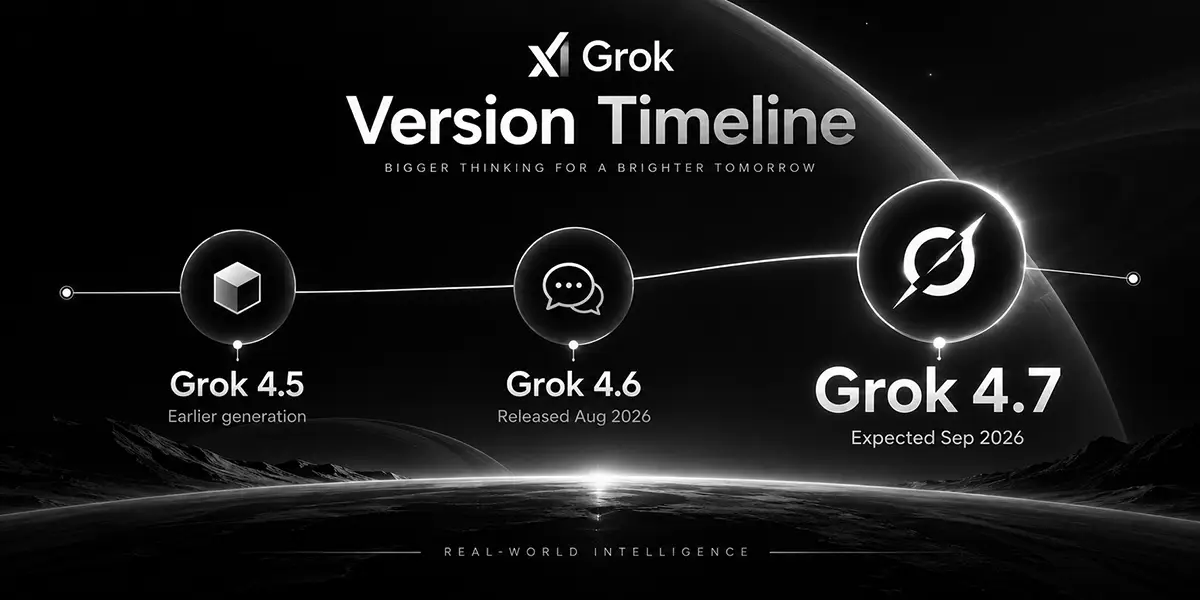
The September 2026 expectation shown for Grok 4.7 illustrates an unverified timing estimate. This is not an official roadmap or evidence of a release date.
What Is Known, and What Still Needs Confirmation?
There is a verifiable starting point: Grok 4.6 has official model documentation describing it as a model for coding, agent tasks, and knowledge work. It supports text and image input, text output, function calling, structured outputs, and reasoning. These details provide a baseline for evaluating a subsequent version. See the official Grok 4.6 model documentation.
For Grok 4.7, this article does not yet have enough verified information to confirm the following:
- Rollout: The official launch date, initial platforms, and whether access will be phased.
- Access and pricing: Eligible subscription plans, API availability, usage limits, and prices.
- Technical changes: Context length, input and output types, and changes to tool use.
- Performance: Reproducible benchmark results, testing configurations, and the size of any improvements on real tasks.
These gaps also limit what comparisons can establish. A new version number does not by itself demonstrate better accuracy, speed, or cost. Likewise, the existence of a product feature does not establish that a new model will support it through every interface.
Three Areas to Watch: What Does a New Model Need to Demonstrate?
The following areas are suggested evaluation priorities, not a list of confirmed Grok 4.7 features. Each concerns improvements users could directly notice in research, coding, and automation.
1. Reasoning Reliability: Do the Conclusions Hold Up?
Complex tasks often require a model to work with multiple sources, competing constraints, and conflicting information. A complete-looking answer does not necessarily reflect sound reasoning. Meaningful progress would mean fewer omitted facts, citations that support the conclusions, and a clear acknowledgment when the available information is insufficient.
For example, when asking a model to assemble a product release timeline, check whether it distinguishes previews from actual launches, confuses availability dates across regions or platforms, and provides a traceable source for each important date.
Coding tasks have similar standards: does the proposed fix solve the original problem, pass existing tests, and avoid introducing regressions? Those outcomes provide better evidence of improved reasoning than an answer's length or tone.
2. Efficiency: How Much Time and Money Does the Same Task Take?
Efficiency is best measured across the entire process, from the initial request to a usable result. A fast first reply may still lead to a longer overall task if it requires repeated clarification, corrections, or reruns.
If Grok 4.7 becomes available through an API, useful measurements under comparable conditions would include:
- Total task completion time and the wait before the response begins.
- Total token usage, tool calls, and retries.
- Cost per successfully completed task, calculated using the applicable billing rules.
A shorter response does not necessarily mean greater efficiency. If it omits necessary evidence, checking and reworking the result still takes time. The ideal improvement would preserve output quality while reducing waiting and repeated effort.
3. Agent Tasks: Can It Execute Reliably and Deliver a Result?
In an agent workflow, a model must select tools, read their results, and decide what to do next as new information arrives. An error at any step can affect the final deliverable, making reliable tool use and recovery from failures important parts of the evaluation.
For a task such as gathering sources and producing a comparison report, check whether the model:
- Chooses suitable sources and retains verifiable citations.
- Passes the correct arguments to search, file-reading, and analysis tools.
- Adjusts its approach after a broken link or tool error rather than repeating the failure.
- Continues to follow the original requirements throughout a long task.
- Clearly identifies what is complete and what still needs human attention.
The number of human interventions is a useful measure. If users repeatedly need to restate the goal, correct tool arguments, or fill in omissions, automation saves less time. The model, tool permissions, and operating environment all influence the outcome, so record them separately rather than attributing every difference in the product environment to model capability.
What Should You Compare with Grok 4.6?
For now, the useful step is to establish a baseline and add results once official Grok 4.7 documentation and access become available. The table below compares the information currently verifiable for this article; it is not a performance ranking.
| Comparison | Grok 4.6 | Grok 4.7 |
|---|---|---|
| Release evidence | Official record: API launch on August 12, 2026 | No formal release entry found in this review |
| Capability documentation | Official model documentation available | Insufficient verified information here to confirm upgrades |
| Timing | Launch is documented | September 12 is a conditional estimate based on an unverified report |
| Performance comparison | Can serve as a baseline on existing tasks | Test under the same conditions once available |
The Grok 4.6 release date comes from the official release notes; its documented capabilities are described on the official model page.
If you already use Grok 4.6, save the inputs, outputs, and completion times for a few common tasks. That gives you a concrete reference when a new version becomes available, rather than relying on a vague recollection of how the older model performed.
Also record the interface, reasoning settings, tool permissions, and test date. Web chat and API usage, or searches enabled and disabled, can produce different results. Documenting those conditions makes the differences easier to interpret.
How to Test Improvements on Real Tasks After Release
Benchmarks help show how a model performs on particular types of questions, but its value for your work still needs testing on practical tasks. Prepare a small set with clear acceptance criteria, such as fact-checking, code fixes, and document analysis.
A reviewable testing process could look like this:
- Keep the task and source material consistent. Give both models the same question, files, and output requirements. If web search is needed, record the sources and access times.
- Define success before testing. Specify which questions a report must address, what evidence its conclusions need, or which tests the code must pass.
- Record the full execution process. Track total time, retries, tool calls, and user clarifications or corrections. For API tests, also record token usage and cost.
- Check the results against each requirement. Verify that citations support the conclusions, important information is covered, code runs, and document analysis or data calculations are accurate.
- Repeat the tests and compare outcomes. Use multiple runs to assess consistency instead of drawing conclusions from one unusually good or poor answer.
The results should help answer concrete questions: has accuracy improved? Are there fewer omissions? Does the output need less manual correction? Can the model deliver the same quality faster or at a lower cost? These answers are more useful for deciding whether to switch models than a broad claim that one is smarter.
Closing Thoughts
The appeal of Grok 4.7 lies in whether potential capability gains translate into more reliable research, steadier tool use, and deliverables that need less rework. Its specific release date and the extent of any improvements still require more verifiable information.
While waiting for formal details, record how your current model performs and prepare your own test tasks. Once the new version is available, use accuracy, completeness, time, and cost to judge whether it is worth adopting.